Diversity & Inclusion at Coca-Cola & Pepsico
Diversity, Inclusion & the Cola Wars
Diversio DEI Expert
Last updated on March 18, 2022
Coke or Pepsi? Regardless of which beverage you’re cheering for in the carbonated version of Game of Thrones, one thing is clear— for over a century, these rival industry giants have pushed each other to appeal to consumers and stakeholders. Within the current sociopolitical climate, the demand for social change has announced, “evolve or get left behind.” Have these competitors pushed each other to apply DEI best practices in the workplace for greater branding recognition and approval? Let’s take a look at how PepsiCo and Coca Cola, two prominent cola industry leaders, have performed in their commitments to DEI and the challenges they’ve faced along the way.
Coca Cola Diversity and Inclusion Strategy v. PepsiCo Diversity and Inclusion Strategy
One effective way to create a culture of diversity and inclusion is by taking preventative measures through diversity training and workshops. These trainings should take proactive steps to foster cross-cultural understandings and establish conflict-resolution systems, resulting in a safer working environment based on tolerance and respect.
So, what are some of the ways Coke and Pepsi incorporate DEI training in the workplace? What practices have helped them move ahead?
- Be transparent and bold. Pepsi has been at the forefront of DEI since the 1940’s, creating an all-Black sales force and electing a woman — actress Joan Crawford — to the board of directors. In 1989, they released the first advertisement fully aired in Spanish. In 2020, the multinational corporation committed to invest $400 million in Black businesses over a 5 year period and to spend another $272 million with Hispanic suppliers by 2020.
In its commitment to support Black businesses, in 2021, Coca Cola took accountability into its own hands, requiring law firms to give a portion of work to Black attorneys specifically and withholding a nonrefundable 30% of fees from those that fail to meet diverse staffing metrics.
Both Coca Cola and PepsiCo’s diversity statistics are publicly available, which increases customer trust and buy-in while holding them accountable to their DEI initiatives. The data discloses and tracks progress across race and ethnicity, and gender.
- Set clear goals and initiatives. PepsiCo has set a goal of achieving 50% women in global management roles by 2025 in its commitment to promoting gender parity. Their commitment to advance racial equality aims to increase U.S. Black and Hispanic managerial representation to 10%.
Similarly, Coca Cola has also released a statement that they want the company to be 50% driven by women stating that balance is not a women’s issue – it is a business issue. Coca Cola diversity statistics indicated better gender equality can lead to a trillion-dollar profitability margin with 85% of CEOs correlating rising bottom lines to formal company diversity and inclusion strategies.
As such, Coca Cola has set clear goals and initiatives under a DEI framework to:
- Provide exposure and access to opportunities to move the leadership landscape towards 50/50 diversity.
- Enable women’s growth and experiences through mobility.
- Lend storytelling platforms that showcase female talent and inspire new generations of leaders.
- Self-audit for bias awareness to foster an inclusive culture, engaging men in these conversations.
PepsiCo’s diversity strategy aims to increase Black representation in managerial roles by 30% and Hispanic representation by 10% by 2025 with 120 managerial positions filled by their Hispanic workforce, including 50 Hispanic executives. They’re planning to add 250 Black associates to managerial roles, including adding a minimum of 100 Black associates to their executive ranks.
They plan to achieve these aims by supporting, and partnering with historical Black universities and National Hispanic organizations. PepsiCo also plans to elevate their recruiting process under a DEI framework by engaging minority-owned search firms to select from diverse candidate talent pools. Through these combined efforts, additional training and mentorship programs, PepsiCo plans to integrate a diversity work culture of inclusion at all levels.
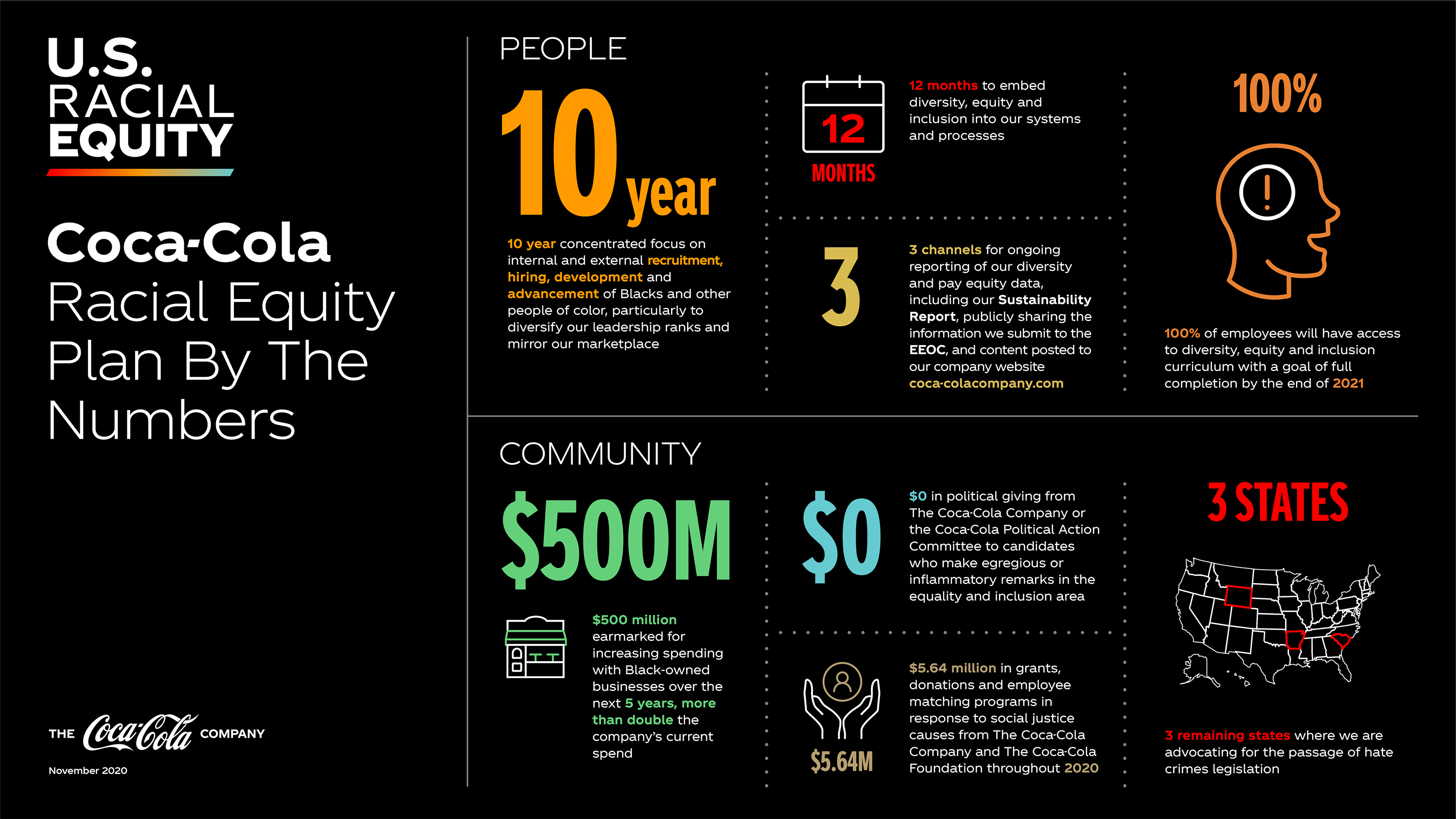
Coca Cola has established a Racial Equity plan with similar aims of filling more leadership roles with minority workforce members and supporting racial and ethnic minority communities, schools, businesses and organizations.
- Third party consulting and outsourcing. Third party consulting and outsourcing can make the process of DEI more meaningful and efficient, while increasing employee engagement thanks to greater trust provided by anonymity.
Coca Cola’s diversity strategy includes conducting a third-party pay equity audit in the U.S. for hourly and salaried employees to ensure associates in equal or similar roles are compensated fairly for their work without regard to gender or race/ethnicity. The results will be shared internally with employees and externally through the company’s annual Business and Sustainability Report.
- Tracking and measuring. The goals set by leadership may be well-intended, but will be all for naught if there is no way to track or measure them through continuous self-assessments of your organization’s progress.
PepsiCo has found that as of Q2 2021, they’ve been able to increase their global female managerial representation to 43% while maintaining a Black and Hispanic managerial representation at 8% and 9% in the U.S., respectively.
Coca Cola has committed to tracking its DEI progress according to its initiative for its minority workforce representation to mirror the market they serve, which is currently measured at 13% Black, 18% Hispanic and 6% Asian. Coca Cola has stated their plans to ensure equity in all decisions will be accomplished through the robust use of strong tools and data in addition to hiring a diversity manager focused on developing an aspirational strategy aligned to their goals.
Tracking and measuring tells you where you are and where you need to be heading.
Coca Cola Diversity Problems v. Pepsico Diversity Problems
Both companies have ensnared themselves in diversity dilemmas, navigating an ever-shifting DEI landscape. Some efforts have missed the mark entirely, coming off as tone-deaf to consumers, others have been subject to backlash in their attempt to dismantle oppressive systems that promote social inequities. As stakeholders, consumers are using their market purchasing power as an effective medium to communicate their dissatisfaction with a company’s less than genuine DEI efforts.
Pepsi felt the sharp sting of a burgeoning, not yet fully-formed cancel culture when they released an ad featuring a then 21-year old Kendal Jenner. The ad was released 6-months into 2016, at the heel of rising tensions in the nation due to racial violence and police brutality.
The ad has gained notoriety for being a modern Much Ado About Nothing, in which a frenzy of ethnically diverse, hip youngsters unify to protest nothing in particular, peaking the interest of none other than Kendal Jenner. Kendal bravely transforms from Kendal Jenner model extraordinaire into Kendal Jenner political activist extraordinaire by shedding her platinum blonde wig and crimson lipstick in exchange for the call of the streets. She gallantly weaves among the throngs of artsy protestors, who have been dammed by a line of shield-bearing police. Then, as if the sword of Godric Gryffindor manifested in front of her, Kendal grabs a can of Pepsi from a nearby cooler and hands it to the nearest police officer, thereby solving racism in America.
The commercial fell flatter than an opened, week-old, plastic Pepsi bottle, leaving a bad taste in the mouths of consumers that resulted in a 4% drop in Pepsi’s brand value to the tune of $18.3 billion according to Brand Finance. The market sent a clear message to PepsiCo that consumers are not interested in performative DEI gimmicks. As stakeholders, they demand a genuine commitment that doesn’t feel as if Pepsi’s interest in promoting social justice is only as valuable as its profitability.
Coca Cola on the other hand, experienced backlash for DEI efforts that some perceived as draconian, like in their efforts to create a more equitable playing field by requiring law firms to give a portion of work to Black attorneys and penalizing firms who did not meet diversity targets.
Coca Cola also came under fire for holding diversity training that urged white group members to “be less white.” Internal “whistleblowers” who took offense to the implications of this training complained it was racially discriminatory.
Coca Cola’s diversity and inclusion issue comes back to what can seemingly be a more difficult concept for lawmakers and certain stakeholders to grasp, as demonstrated by their rejection of implementing more equitable practices. Equity becomes conflated with equality. As the saying goes “when you’re accustomed to privilege, equality feels like oppression.” That perceived oppression created an outraged response to Coca Cola’s DEI initiative plan with real consequences for their brand image.
Coca Cola v. Pepsico: And the Winner Is…
Findings from Diversio’s Public Markets Dashboard reveal that these global industry giants go neck in neck when it comes to doing DEI best practices. Like the fizzy soft drinks we love to consume, the fundamentals of a successful DEI recipe are similar. Let’s take which company has strategically come out on top, according to their ability to implement DEI best practices across diversity, inclusion, and commitment in comparison to the industry standard.
Diversity Scoring for Coca-Cola vs. Pepsico
When it comes to diversity rankings, Coca Cola falls into the 97th percentile with a score of 70/100 whereas PepsiCo falls into the 55th percentile with a score of 64/100.
Board-Level Gender Parity. Coca-cola scored 41.7% while Pepsico received a score of 41.5%. These averages are ranked slightly above the industry average of 40.5%.
Board-Level Racial & Ethnic Diversity. Coca-cola measured in at 25%, while Pepsico has taken a statistically significant lead at 38.5%. Both industry giants are greatly outperforming the industry average of 10.7%.
Executive Gender Parity Diversity. This time Coca-cola has charged ahead with a gender parity score of 42.5% while Pepsico lags behind at 18%. It also lags behind the industry average of 27.7% in its gender parity initiatives.
Executive Racial & Ethnic Diversity. Coca-cola is also ahead here ranking at 22.5% while Pepsico trails behind at 9% with an industry average of 11.9%
Inclusion Ranking for Coca-Cola vs. Pepsico
Inclusion is graded on a scale from 1-10. Here’s how each company did based on the following categories:
Inclusive Culture. Coca-cola and Pepsico are neck in neck when it comes to creating an inclusive culture in the workplace with Coca-cola ranked at 5.2 and Pepsico slightly ahead with a 5.6.
Fair Management. Again, just a few fractions of a point distinguish these soda companies. Coca-Cola received a score of 7.2 for fair management while Pepsico received a score of 6.5.
Career Development. Offering career development opportunities at Coca-Cola was appraised at 6.4 based on our metrics while Pepsico’s career development is valued at 6.1.
Workplace Flexibility. Coca-Cola has a slight advantage over Pepsico when it comes to workplace flexibility with a score of 5.9 in comparison to Pepsico’s 4.8 scoring.
Workplace Safety. Both beverage companies offer a relatively high rate of workplace safety, with Coca-cola coming in at a 7.2 and Pepsico at a 7.6.
Recruiting & Hiring. Recruiting and hiring practices are ranked almost identically with Coca-Cola receiving a score of 6.4 and Pepsico receiving a score of 6.3.
All in all, when it comes to inclusion, Coca Cola falls into the 56th percentile with a score of 64/100 whereas PepsiCo falls into the 81st percentile with a score of 62/100.
Commitment Scoring and Ranking for Coca-Cola vs. Pepsico
Each organization’s commitment to their DEI initiatives is ranked based on several categories as follows:
- Policy and Governance. Policies in place to track, review, and improve effectiveness on DEI initiatives at Coca-Cola received a score of 2 out of 3 whereas Pepsico received full marks with a score of 3 out of 3.
- Talent Acquisition Strategy. Programs in place to recruit diverse talent and increase minority representation at each company both received full marks, scoring 3 out of 3.
- Employee Engagement. Programs in place to support diverse talent and ensure a safe and inclusive workplace at Coca-cola received 3 out of 3 while programs at Pepsi scored 2 out of 3.
- Transparency and Data Disaggregation. Commitment to disclose organizational diversity beyond what is required by regulation was ranked lower at Coca-Cola compared to Pepsico with a score of 1 out of 3 while Pepsico received the full 3 out of 3.
In total it was found that in their commitment efforts, Coca Cola landed in the 34th percentile with a score of 75/100 whereas PepsiCo landed in the 64th percentile with a score of 92/100.
Using Diversio’s scoring metrics, overall, Coca Cola was found to be in the 92nd percentile of publicly traded companies with a total score of 68/100 while PepsiCo was ranked to be in the 55th percentile with a score of 64/100. Although neither company is way ahead of the curve from the other in their DEI efforts, rivalry for positive branding and public sentiment has forced them both to get aggressive in their DEI efforts. We’ve glimpsed into how these MNCs compare against the industry standard, and whether they can be considered role models, leading other organizations in the industry to promote DEI best practices in the workplace and beyond. That neither company can afford to be seen as lagging behind the other has been a force for positive change. Overall, by virtue of the available data, we can see that these colossal cola companies are doing better than the competition, but still have significant room for growth.
Actionable Solutions for Your Workplace
For companies across a variety of industries, both public and private, Diversio’s language-intelligence platform combines AI technology with human intelligence to help organizations identify, track and measure DEI efforts in the workplace. We collect aggregate data differentiating for variances in experiences across workforce populations using a 4-minute anonymous survey linked to 6 research-based KPIs. Data is then translated into readily available, actionable solutions, implemented according to your organization’s unique location in the DEI landscape.